

Share Foundation report urges next steps to unlock £millions and to develop life skills for disadvantaged young adults.
Aylesbury, Buckinghamshire: 24 September 2026 – A new report published by youth charity, The Share Foundation, shows its partnership with the government has delivered substantial benefits for young people in care and, on a general basis, for young owners of Child Trust Funds (CTFs) across the UK. However, the charity is also calling for government to take action to enable them to do more to empower young people from disadvantaged and low-income backgrounds and improve intergenerational rebalancing.
The Share Foundation’s mission is to help children and young people whose family situation is disadvantaged or non-existent to achieve their potential, by providing support in the form of financial resources and education.
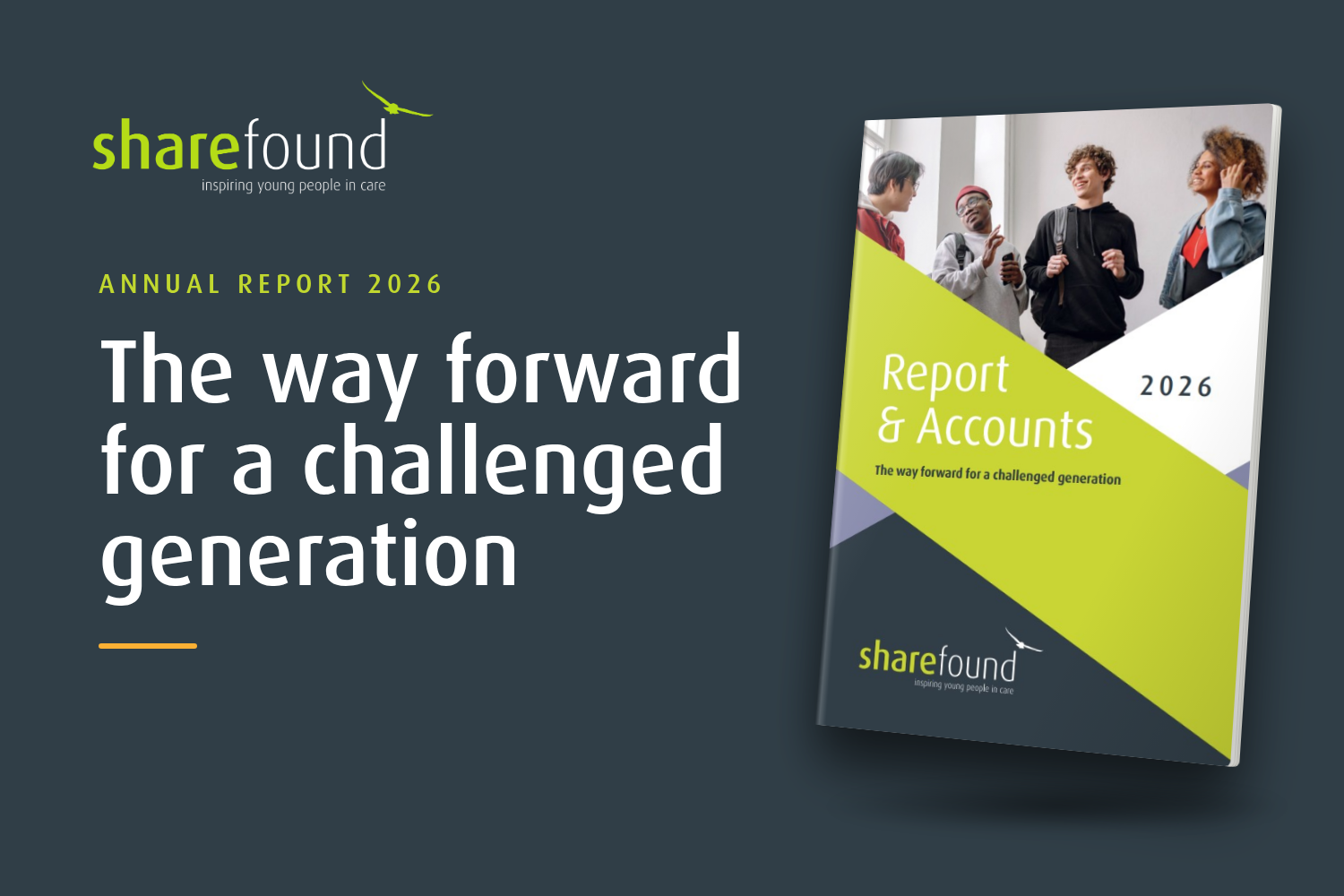
Its ‘The way forward for a challenged generation’ 2026 annual report reveals that during the last financial year the Department for Education provided £3.125 million for opening new Junior ISAs while The Share Foundation also arranged for an additional £6.162 million to be contributed to the accounts which it administers for young people in care.
The Share Foundation’s achievements set out in the report also include:
Accelerating the rate of helping CTF owners to find their accounts. The Share Foundation’s general CTF recovery programme has so far linked 130,000 applicants with accounts worth over £300 million.
Over 2,486 young people in care have benefited from The Share Foundation’s philanthropically-funded, incentivised learning financial education programme, Stepladder Plus, and its performing arts programme, Stepping Forward. Young people have earned over £1.79m to date when engaging in these programmes, with over 64% completing at least four out of six steps of the Stepladder Plus programme earning an average of £754.
A proactive programme of signing bi-lateral agreements with individual local authorities and health trusts which enables The Share Foundation (whose contracted role ends at age 18) to continue with its work in order to ensure that young people’s accounts are delivered effectively. As of 31 March 2026, The Share Foundation had received 79 signed agreements out of 211 sent. The search facilities enabled by these agreements are now reaching 6,177 adult care leavers across these local authorities, and the claim rates achieved by The Share Foundation follow-up process are now averaging 54% for Junior ISA accounts and 73% for CTF accounts.
These schemes are invaluable as a catalyst for providing comprehensive UK-wide access and support for young people in care, and The Share Foundation’s introduction of life skills programmes providing incentivised learning is transforming adult care leavers’ potential by achieving substantial reductions in their NEET rate.
However, The Share Foundation has identified several key areas in which the government could take action to improve inter-generational rebalancing:
Introduce an automatic release process for HMRC-allocated accounts when their young owner reaches 21 years of age. This would forthwith release over £676 million of accounts, £447 million of which would be credited to low-income young adults, at no cost to the government.
For the government to provide the necessary regulation and logistics to enable a philanthropically funded ‘CTF Mark 2’ to be introduced for the benefit of young people from low-income backgrounds. This wholly HMRC-allocated scheme would learn from the original scheme to include incentivised financial awareness training and an automatic release process at age 21 for unclaimed accounts.
The incentive payments for Stepladder Plus in England, Wales and Northern Ireland, which are set at a maximum of £750, are entirely funded by philanthropic donations; the Scottish government continues to contribute 50% of the cost, enabling The Share Foundation to maintain the full incentive level of up to £1,500 for their young people. With the programme now showing a major benefit to public finances as a result of reduced NEET levels, The Share Foundation continues to ask the UK government to help fund the programme.
Gavin Oldham OBE, Chair of Trustees at The Share Foundation, says: “A lot has been achieved in the 14 years during which we have managed the provision of financial resources and life skills for over 220,000 young people in care throughout the UK on behalf of the Department for Education.
“Additionally, we have also linked 130,000 young applicants generally with their Child Trust Fund accounts worth over £300 million. But we can provide detailed analysis showing that there are still nearly one million unclaimed accounts worth over £2 billion, over 60% of which is held in HMRCallocated accounts. This is why we continue to press for an ‘Automatic Release at 21’ process for HMRC-allocated Child Trust Fund account holders, where the low-income proportion is 70% higher than for family-opened accounts, and we hope an announcement on this will be made in the October Budget. Once this has been actioned by government, we will also work hard to introduce a ‘Child Trust Fund Mark 2’ for low-income young people.
“Incentivised learning is also proving its worth in providing attitudinal transformation for young people from disadvantaged backgrounds. This is demonstrated through our Stepladder Plus programme which is more than halving the excess NEET rate adult care leavers. This was first established by public service research company, Mutual Ventures, in 2023, and we are now undertaking more detailed analysis with Sussex University. Stepladder Plus is thereby significantly reducing the public finance cost of providing welfare support for NEET adults. “‘Earn-as-you-learn’ encourages participation on a continuing basis, during which the attitudinal change sets in. In a world in which so many young people see nothing but despair and lack of opportunity, incentivised learning has a major part to play in tackling inter-generational injustice”, Oldham concludes.
Contact: Gavin Oldham OBE 07767-337696